
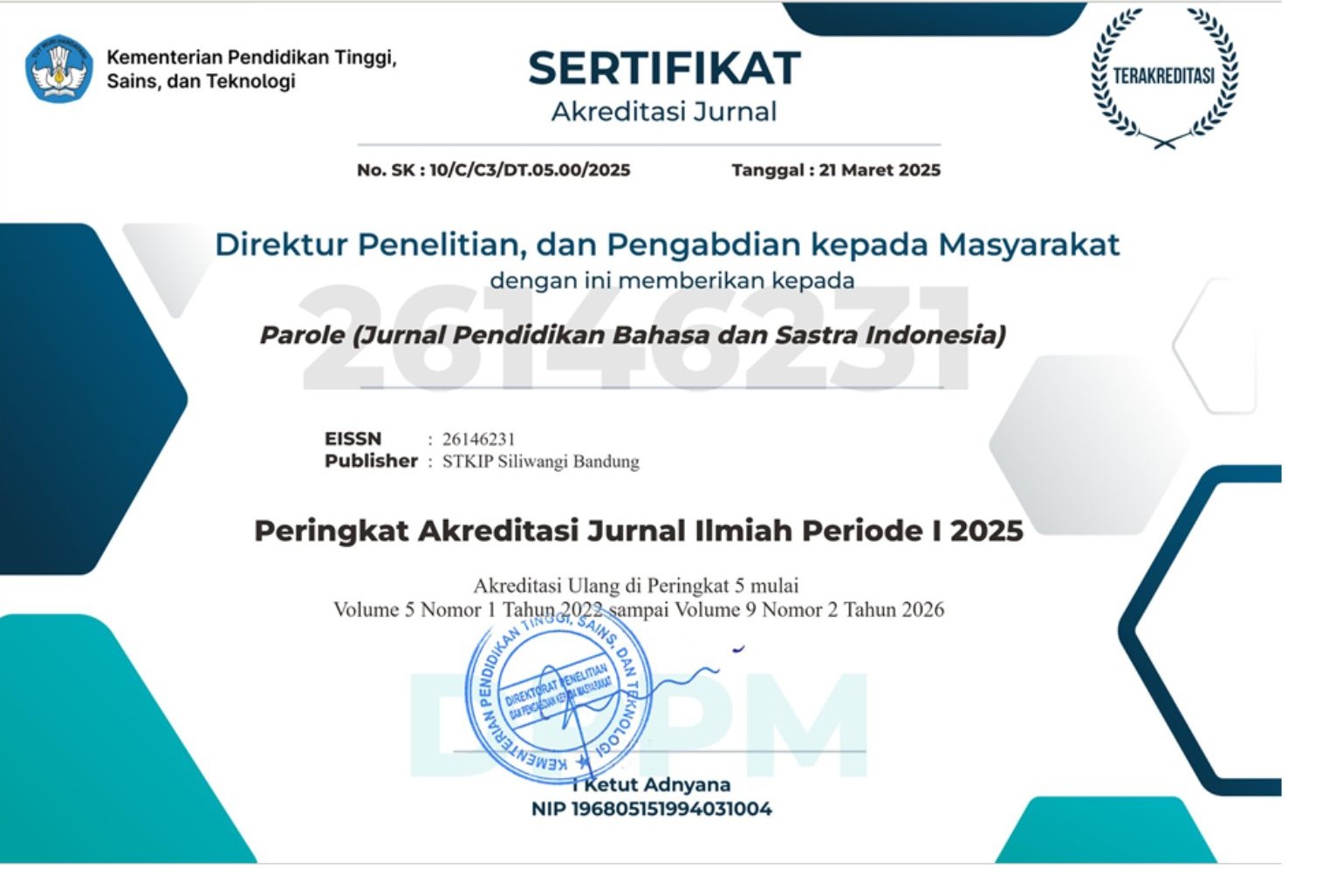

All manuscripts submitted to Parole: Jurnal Pendidikan Bahasa dan Sastra Indonesia undergo an initial screening by the editorial team to determine their suitability for the journal's focus and scope, compliance with the author guidelines, and adherence to publication ethics standards.
During this stage, the editor assesses the manuscript's relevance, originality, structure, academic quality, and general methodological appropriateness. The manuscript is also screened for similarity using plagiarism-detection software, such as Turnitin, to identify potential overlap with previously published works.
Manuscripts that do not meet the journal's basic requirements or are outside its scope may be rejected without external peer review. Manuscripts that pass the initial screening proceed to the peer-review stage.
Parole applies a double-blind peer-review process, in which the identities of authors and reviewers are concealed from one another throughout the review process.
Each manuscript that passes the initial editorial screening is evaluated by at least two independent reviewers with relevant expertise in Indonesian language education, linguistics, literature, or related fields.
Reviewers evaluate manuscripts based on the following criteria:
Relevance and Scope: The manuscript's alignment with the journal's focus and scope.
Originality and Novelty: The originality of the research and its contribution to existing knowledge.
Scientific Contribution: The significance and implications of the research findings for language education, linguistics, literature, or related fields.
Methodological Quality: The appropriateness, clarity, and rigor of the research design, methods, data collection, and analysis.
Presentation and Organization: The clarity of the title, abstract, introduction, results, discussion, conclusions, and overall manuscript structure.
Literature and References: The relevance, adequacy, accuracy, and appropriate use of scholarly references.
Research Ethics: Compliance with applicable ethical standards and responsible research practices.
Reviewers provide constructive comments, identify strengths and weaknesses, and recommend whether the manuscript should be accepted, revised, or rejected.
Based on the reviewers' reports and the editor's assessment, the editorial team will make a publication decision. The possible decisions are:
Accept Submission: The manuscript is accepted for publication without further substantive revisions, subject to applicable editorial and production requirements.
Revisions Required: The manuscript requires minor or major revisions before it can be considered for acceptance. The editor may assess the revised manuscript directly or send it back to the reviewers, depending on the extent of the revisions.
Resubmit for Review: The manuscript requires substantial revision and must undergo another round of peer review before a final decision can be made.
Decline Submission: The manuscript is rejected because it does not meet the journal's scholarly, methodological, ethical, or editorial standards.
Resubmit Elsewhere: Where appropriate, the editor may recommend that a manuscript unsuitable for Parole be submitted to a more suitable journal.
Reviewer recommendations inform editorial decisions but do not automatically determine the final outcome. The Editor-in-Chief or an authorized editor is responsible for the final publication decision.
The peer-review process is expected to take approximately 4–8 weeks, depending on reviewer availability, manuscript complexity, and the number of revision rounds required.
This period is an estimate rather than a guaranteed deadline. The journal will communicate significant delays to the corresponding author when appropriate.
Authors invited to revise their manuscripts must submit the revised version within the deadline specified in the editorial decision letter. Unless otherwise stated by the editor, the standard revision period is a maximum of four weeks.
Authors must provide a revised manuscript and a point-by-point response explaining how each reviewer comment has been addressed. If a requested revision cannot be implemented, the authors should provide a clear academic justification.
Extensions may be considered upon request and are subject to editorial approval. Failure to submit a revision within the specified period may result in the manuscript being treated as withdrawn or requiring a new submission, at the editor's discretion.
The editorial team will communicate the reviewers' comments and the editorial decision to the corresponding author.
Authors are expected to respond professionally and address the reviewers' comments thoroughly. Revised manuscripts may be returned to the original reviewers or assessed by the editor to determine whether the requested changes have been implemented adequately.
When additional review is necessary, the manuscript may undergo further rounds of evaluation. Acceptance is granted only when the editor is satisfied that the manuscript meets the journal's scholarly and editorial standards.
The corresponding author is responsible for managing communication with the editorial office on behalf of all co-authors.
The corresponding author must:
Ensure that all authors meet the journal's authorship criteria and have approved the submitted manuscript.
Verify that all authors' names, affiliations, and contact details are accurate.
Confirm that all authors agree with the order in which their names appear in the manuscript.
Coordinate the preparation and submission of revisions.
Submit responses to reviewer comments and provide additional information requested by the editor.
Ensure that all co-authors approve the final version before publication.
All manuscript-related communication must be conducted through the official submission system or the editorial contact channels provided on the Parole website.
For transparency and clarity, the journal distinguishes between the following manuscript versions:
Accepted Manuscript
The version of the article accepted for publication after the peer-review process and the completion of any required revisions, before final copyediting, typesetting, and production.
Version of Record
The final, formally published version of the article that has completed the journal's editorial and production processes. It includes the final text, formatting, bibliographic metadata, DOI where applicable, and any subsequent published corrections or updates linked to the article.
The Version of Record serves as the authoritative version of the article for citation and scholarly reference.
All manuscripts and reviewer reports are treated as confidential during the peer-review process. Reviewers must not disclose, distribute, or use unpublished manuscript content for personal or professional advantage.
Reviewers must declare any actual, potential, or perceived conflicts of interest and decline assignments when impartiality cannot be adequately maintained.
Editors and reviewers are expected to evaluate manuscripts objectively, respectfully, and independently. The journal does not tolerate manipulation of peer review, plagiarism, fabricated or falsified research, or other forms of publication misconduct.
Any concerns about research integrity identified during peer review will be handled in accordance with the journal's publication ethics policies.
Parole is committed to ensuring that publication decisions are based on scholarly merit, originality, relevance, methodological quality, research integrity, and the journal's editorial standards.
Editorial decisions must not be improperly influenced by personal relationships, institutional affiliations, financial interests, or external pressure. Any conflicts of interest must be disclosed and appropriately managed.
Questions concerning manuscript submissions, peer review, editorial decisions, or revisions should be directed to the Parole Editorial Office through the official communication channels provided on the journal's website.
Journal: Parole: Jurnal Pendidikan Bahasa dan Sastra Indonesia
Publisher: IKIP Siliwangi, Indonesia
Official Website: https://journal.ikipsiliwangi.ac.id/index.php/parole