About the Journal
Jurnal Profesi Pendidikan (JPP) (p-ISSN 2829-0828; e-ISSN 2828-8831) is a peer-reviewed, open-access journal published by PPG IKIP Siliwangi in collaboration with Forum Penyelenggara Pendidikan Profesi Guru (FP-PPG). JPP publishes original research articles on teaching and learning that address current issues in education across early childhood, elementary, secondary, and higher education, with particular attention to teacher professional education.
The journal welcomes a range of research designs, including classroom action research, qualitative, quantitative, and mixed-methods research, Didactical Design Research (DDR), and Research and Development (R&D).
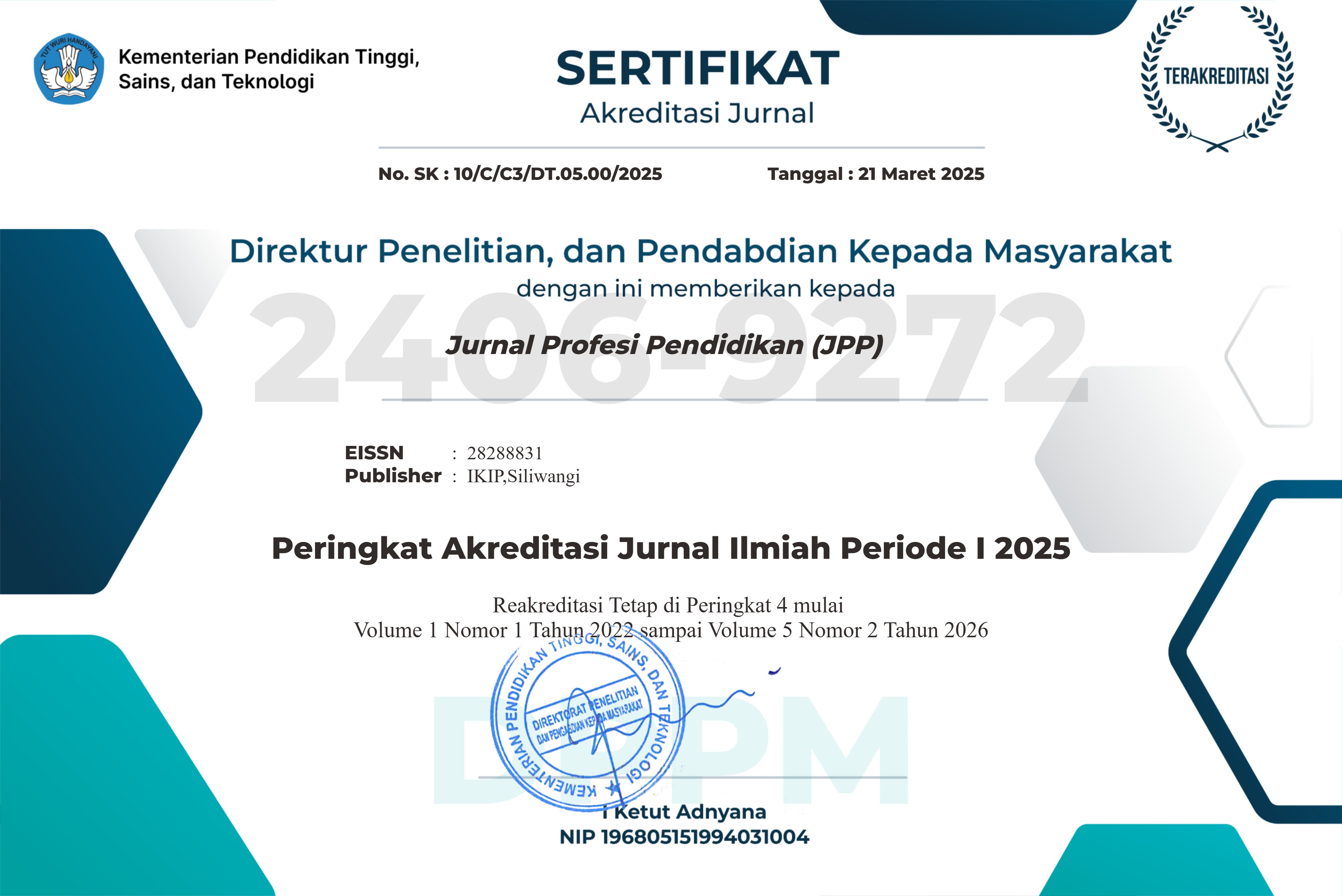
JPP is published twice a year, in June and December. Manuscripts are accepted in English or Indonesian, and all abstracts are published in English. JPP is accredited SINTA 4 by the Ministry of Education, Culture, Research, and Technology of the Republic of Indonesia, as stated in Accreditation Decree No. 10/C/C3/DT.05.00/2025.
Focus and Scope
JPP focuses on research that improves the quality of teaching and learning and supports the professional development of teachers, from early childhood to higher education. The scope of the journal includes:
- Teaching, learning, and instructional strategies
- Curriculum development and evaluation
- Learning environments and innovative learning
- Teacher education and professional development, including teacher professional education (PPG)
- Educational technology and digital pedagogy
- Educational development and policy
Manuscripts outside this scope will be declined at the initial screening stage.
Peer Review Process
- Initial screening. Every submission is first examined by the editor for its fit with the focus and scope, compliance with the journal template, and similarity level using Turnitin (maximum 20%). Manuscripts that do not meet these requirements are declined or returned to the authors.
- Double-blind peer review. Manuscripts that pass the initial screening are reviewed by at least two independent reviewers with relevant expertise. The identities of authors and reviewers are concealed from each other. Reviewers assess originality, contribution, methodological rigor, relevance, and clarity of presentation.
- Review period. The review process takes approximately 4 to 8 weeks.
- Decision categories. Based on the reviewers’ reports, the editor makes one of the following decisions:
- Accept: the manuscript is accepted in its current form.
- Accept with Revisions: the manuscript will be accepted after minor or major revisions, which are checked by the editor.
- Resubmit for Review: the manuscript requires substantial revision and a second round of review.
- Reject: the manuscript will not be published and may not be resubmitted to JPP.
- Revision. Authors are expected to return revised manuscripts within four weeks. Revisions received after this period may be treated as new submissions.
- Final decision. The final decision is made by the Editor-in-Chief in an editorial board meeting, based on the reviewers’ recommendations.
Publication Frequency
JPP is published twice a year: Number 1 in June and Number 2 in December. The journal has been published regularly since Volume 1 Number 1 (June 2022).
Open Access Policy
JPP provides immediate open access to all of its content on the principle that making research freely available to the public supports a greater global exchange of knowledge. All articles can be read, downloaded, copied, distributed, printed, searched, and linked to in full text without charge and without registration, in accordance with the Budapest Open Access Initiative (BOAI) definition of open access and the terms of the CC BY-SA 4.0 license.
Archiving
JPP uses the LOCKSS system through the PKP Preservation Network (PKP PN) to ensure the permanent preservation of all published content. Article metadata are deposited with Crossref, and published articles are also available through GARUDA (Garba Rujukan Digital).
Copyright and License
Authors retain the copyright of their articles without restrictions. All articles are published under the Creative Commons Attribution-ShareAlike 4.0 International License (CC BY-SA 4.0). Full terms are available on the [Copyright Notice] and [License] pages.