Kemampuan berpikir komputasi siswa SMP ditinjau berdasarkan adversity quotient: Analisis studi kasus
DOI:
https://doi.org/10.22460/jpmi.v8i4.25817Keywords:
Computational Thinking, Linear Equations System with Two Variable, Adversity QuotientAbstract
Computational thinking is an important 21st-century skill that students need to learn. This study aims to describe students’ computational thinking abilities in solving mathematical problems, reviewed from the adversity quotient (AQ) types: quitters, campers, and climbers. This research employed a qualitative approach based on a case study with the perspective of grounded theory. Six eighth-grade students from a public junior high school in Cimahi were chosen, with two students selected for each AQ type. Data were collected through two steps which are tests and interviews, then analyzed using NVivo 14 (trial version). Computational thinking skills were analyzed based on eight categories: (1) problem identification, (2) formulation of a mathematical representation, (3) recognition of regularities, (4) determination of the pattern, (5) analysis of key characteristics, (6) formulation of alternative solutions, (7) develop the solution steps, and (8) draw a conclusion. The results showed that quitters demonstrated categories 1, 2, 3, 7, and 8; campers fulfilled categories 1, 2, 3, 5, 6, and 7; and climbers achieved categories 1, 2, 3, 4, 5, 6, and 7. These differences were influenced by the distinct characteristics of each AQ type. AQ could become the basis to design adaptive learning strategies to enhance students’ computational thinking abilities.
References
Afri, L. D. (2018). Hubungan adversity quotient dengan kemampuan pemecahan masalah siswa SMP pada pembelajaran matematika. Axiom: Jurnal Pendidikan Dan Matematika, VII(2), 47–53. http://jurnal.uinsu.ac.id/index.php/axiom/article/view/2895
Barr, V., & Stephenson, C. (2011). Bringing CT K12 role of CS education. Acm Inroads, 2(1), 48–54. https://doi.org/10.1145/1929887.1929905
Cahyo, A., & Setianingsih, R. (2013). Tipe berpikir siswa dalam memecahkan masalah pada materi sistem persamaan linear dua variabel di kelas VIII SMPN 1 Pacet. MATHEdunesa, 2(3), 1–8. https://jurnalmahasiswa.unesa.ac.id/index.php/mathedunesa/article/download/3875/6421
Hunsaker, E. (2020). Computational thinking in the K-12 educational technology handbook. In K-12 Educational Technology Handbook (1st ed.). EdTech Books. https://edtechbooks.org/k12handbook
ISTE, & CSTA. (2011). Computational thinking leadership toolkit in computational thinking leadership toolkit first edition (Vol. 28, Issue 1).
Lee, T. Y., Mauriello, M. L., Ingraham, J., Sopan, A., Ahn, J., & Bederson, B. B. (2012). CTArcade: learning computational thinking while training virtual characters through game play. In CHI’12 Extended Abstracts on Human Factors in Computing Systems (pp. 2309–2314). Association for Computing Machinery. https://doi.org/10.1145/2212776.2223794
OECD. (2018). PISA 2022 MATHEMATICS FRAMEWORK ( DRAFT ).
Özgür, H. (2020). Relationships between computational thinking skills, ways of thinking and demographic variables: A structural equation modeling. International Journal of Research in Education and Science, 6(2), 299–314. https://doi.org/10.46328/ijres.v6i2.862
Rosali, D. F. (2022). Learning obstacles siswa SMP dalam berpikir komputasi pada materi pola bilangan. (Tesis). Magister Penidikan Matematika, Universitas Pendidikan Indonesia. http://repository.upi.edu/71191/
Sa’diyyah, F. N., Mania, S., & Suharti. (2021). Pengembangan instrumen tes untuk mengukur kemampuan berpikir komputasi siswa. Jurnal Pembelajaran Matematika Inovatif, 4(1), 17–26. https://doi.org/10.22460/jpmi.v4i1.17-26
Stolz, P. G. (2000). Adversity quotient: mengubah hambatan menjadi peluang. PT Grasindo.
Strauss, A. L., & Corbin, J. M. (1998). Basics of qualitative research: techniques and procedures for developing grounded theory. SAGE Publications, Inc.
Sung, W., & Black, J. B. (2020). Factors to consider when designing effective learning: infusing computational thinking in mathematics to support thinking-doing. Journal of Research on Technology in Education, 53(4), 404–426. https://doi.org/10.1080/15391523.2020.1784066
Supiarmo, M. G., Turmudi, & Susanti, E. (2021). Proses berpikir komputasional siswa dalam menyelesaikan soal PISA konten change and relationship berdasarkan self-regulated learning. Numeracy, 8(1), 58–72. https://doi.org/10.46244/numeracy.v8i1.1378
Susanti, R. D., & Taufik, M. (2021). Analysis of student computational thinking in solving social statistics problems. SJME (Supremum Journal of Mathematics Education), 5(1), 22–31. https://doi.org/10.35706/sjme.v5i1.4376
Usta, N., & Düzalan, N. (2021). Thematic analysis of studies on computational thinking in education in Turkey and abroad *. International Journal of Humanities and Social Science Invention (IJHSSI), 10(September), 17. https://doi.org/10.35629/7722-1008022238
Wahyudin. (2022). Rancangan grounded theory. (Tidak Diterbitkan).
Weintrop, D., Beheshti, E., Horn, M., Orton, K., Jona, K., Trouille, L., & Wilensky, U. (2016). Defining computational thinking for mathematics and science classrooms. Journal of Science Education and Technology, 25(1), 127–147. https://doi.org/10.1007/s10956-015-9581-5
Downloads
Published
Issue
Section
License

This work is licensed under a Creative Commons Attribution-ShareAlike 4.0 International License.
The author is responsible for acquiring the permission(s) to reproduce any copyrighted figures, tables, data, or text that are being used in the submitted paper. Authors should note that text quotations of more than 250 words from a published or copyrighted work will require grant of permission from the original publisher to reprint. The written permission letter(s) must be submitted together with the manuscript.Article Metrics
Abstract view : 0 timesPDF - 1618 times
Language
Akreditasi
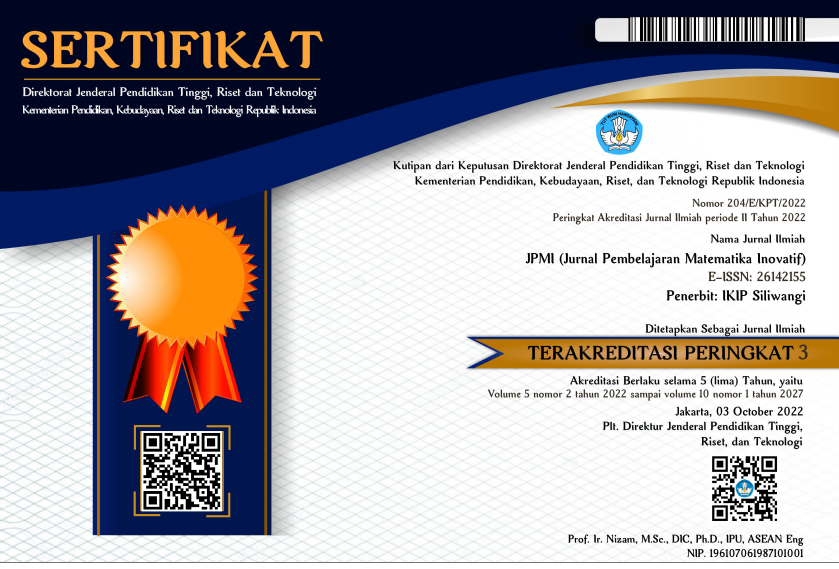
Template

Addional Menu









Indexing






Recomended Tools