Penyerahan Naskah

Perlu Login atau Daftar untuk menyerahkan naskah.

Daftar Tilik Penyerahan Naskah

Penulis yang ingin memasukkan naskah harus memperhatikan poin-poin di bawah ini. Jika naskah tidak sesuai dengan persyaratan yang telah dicantumkan, ada kemungkinan naskah tersebut akan dikembalikan.

Panduan Penulis

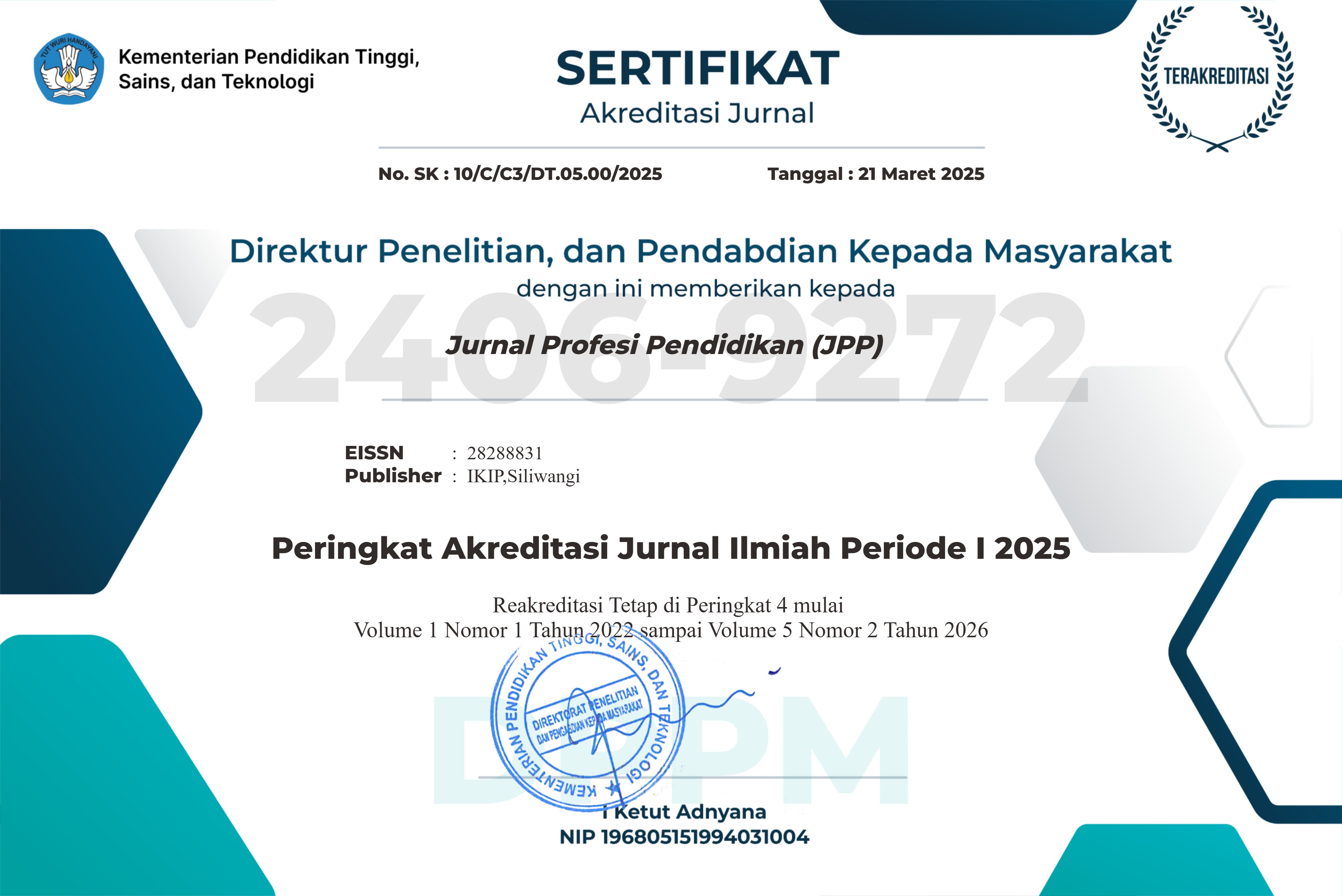
Jurnal Profesi Pendidikan (JPP) is a peer-reviewed, open-access journal published by PPG IKIP Siliwangi in collaboration with Forum Penyelenggara Pendidikan Profesi Guru (FP-PPG). The journal is published twice a year, in June and December. Manuscripts must fall within the journal’s Focus and Scope and follow the JPP Template.


1. Manuscript Type

JPP accepts original research articles reporting empirical studies on teaching and learning, including classroom action research, qualitative, quantitative, and mixed-methods research, Didactical Design Research (DDR), and Research and Development (R&D). Manuscripts must be original, must not have been published previously, and must not be under consideration by another journal.


2. Language

Manuscripts may be written in English or Indonesian. The title, abstract, and keywords must be written in English. Authors are encouraged to ensure proper language use before submission.


3. Authorship Criteria

Each person listed as an author must meet all of the following criteria:

  1. a substantial contribution to the conception or design of the study, or to the acquisition, analysis, or interpretation of data;
  2. drafting the manuscript or revising it critically for important intellectual content;
  3. approval of the final version to be published; and
  4. accountability for the accuracy and integrity of all parts of the work.

Contributors who do not meet these criteria should be listed in the Acknowledgments. The contribution of each author must be stated using the CRediT (Contributor Roles Taxonomy). The corresponding author is responsible for ensuring that all co-authors have approved the author order and the final manuscript before submission. Generative AI tools cannot be listed as authors.


4. Manuscript Submission

All manuscripts must be submitted through the journal’s online submission system. Authors must register before submitting. To support double-blind peer review, authors must upload two separate files:

  • Title Page: article title, full names of all authors, institutional affiliations, countries, ORCID iDs, and the corresponding author’s email address.
  • Blinded Manuscript: the full text (title, abstract, keywords, main text, figures, tables, and references) without any author names, affiliations, acknowledgments, or other identifying information, including in the file properties.

5. Manuscript Structure

  • Title: concise and informative, maximum 15 words, Cambria 14 pt, bold, centered.
  • Authors: full names without academic titles, followed by affiliations (department, university, country), marked with superscript numbers
  • Abstract: 120–250 words in English, written in the past tense, stating the background, purpose, methods, main results, and conclusions, without citations.
  • Keywords: three to five keywords.
  • Introduction: background, research problem, review of related studies, research gap, novelty, and purpose of the study.
  • Method: research design, participants or subjects, instruments, procedures, data collection, and data analysis.
  • Results and Discussion: findings supported by tables or figures, interpreted and compared with previous studies.
  • Conclusion: answers to the research questions, followed by implications and recommendations, written in paragraph form.
  • Declarations (in the Title Page during review, added to the manuscript after acceptance): Acknowledgments, Funding, Author Contributions (CRediT), Conflict of Interest, and Ethics Statement.
  • Declaration of Generative AI and AI-assisted technologies in the writing process: placed immediately above the References, in accordance with the journal’s Generative AI Policy.
  • References: APA 7th Edition style.

6. Formatting

  • Paper size: A4 (21 × 29.7 cm); margins 2.5 cm on all sides; header 1.3 cm; footer 1.27 cm.
  • Font: Cambria 12 pt, 1.15 line spacing.
  • Length: minimum 4,000 words excluding references, and maximum 30 pages.
  • Headings are written without numbering.
  • Figures and tables are placed within the text near their first mention, centered, numbered consecutively with Arabic numerals, and given clear captions. Tables use no vertical lines.

7. References

  • All citations and references must follow APA 7th Edition and must be managed using a reference manager (e.g., Mendeley, Zotero, or EndNote).
  • A minimum of 20 references is required.
  • At least 80% of the references must be primary sources (journal articles, theses, or conference proceedings), and at least 75% must have been published within the last five years.
  • Authors are responsible for the accuracy of all references; fabricated or unverifiable references will lead to rejection.

8. Research Ethics

Studies involving human participants must state that the procedures complied with relevant ethical standards and, where applicable, were approved by an ethics committee or institutional review board. Informed consent must be obtained from all participants; for studies involving children, consent from parents or guardians and assent from the children are required. Participants’ identities must be protected.


9. Review Process

Manuscripts are first screened by the editor for scope, template compliance, and similarity (maximum 20%, checked with Turnitin). Eligible manuscripts are reviewed by at least two independent reviewers under a double-blind process, which takes approximately 4 to 8 weeks. Editorial decisions are: Accept, Accept with Revisions, Resubmit for Review, or Reject. See the Peer Review Process for details.


10. Revision

Revised manuscripts must be returned within four weeks, together with a response letter addressing each reviewer comment. Revisions received after this period may be treated as new submissions.


11. After Acceptance

  • Accepted manuscripts undergo copyediting and layout editing; authors are asked to check and approve the galley proof.
  • A graphical abstract is required after acceptance: minimum 531 × 1328 pixels (height × width), in TIFF, EPS, JPG, PDF, or MS Office format. AI-generated artwork is not permitted.
  • Publication fees apply only after acceptance; see Author Fees.

12. Copyright and License

Authors retain the copyright of their articles without restrictions. Articles are published under the Creative Commons Attribution-ShareAlike 4.0 International License (CC BY-SA 4.0).


13. Contact

For technical assistance, please contact the editorial office at jpp@journal.ikipsiliwangi.ac.id or WhatsApp +62 852-2284-0857.

Pernyataan Privasi

Nama dan alamat email yang dimasukkan di website ini hanya akan digunakan untuk tujuan yang sudah disebutkan, tidak akan disalahgunakan untuk tujuan lain atau untuk disebarluaskan ke pihak lain.